
Attic mold in Plano is rarely a mystery once someone looks. The attic sits at outdoor dew point for five months a year, the roof has probably been hit by hail at least once, and the air conditioner is often parked up there dripping condensate. This guide explains the three common sources, how to spot each from inside the house, what the fix involves and what Texas rules apply.
Plano Mold Experts is a free quote service. We connect Plano and Collin County homeowners with independent, TDLR-licensed Texas mold assessment and remediation companies. We do not do the work, and roofers and AC contractors are separate trades.
Source 1: hail-damaged roofs that leak slowly
North Texas sits in one of the most active hail corridors in the country. The June 13, 2012 storm, which the National Weather Service lists among the costliest Texas hailstorms, started over Plano and moved south along US 75. The April 11, 2016 supercell hit Plano, Wylie, Frisco and Allen with hail up to four inches; in Wylie alone about 80 percent of homes were damaged. FEMA's May 2024 declaration for severe storms (DR-4781) covers Collin County too.
A roof replaced after a storm is not the problem. The problem is the roof that was bruised but not replaced, or replaced with flashing that was never resealed. Water gets in a little at a time, soaks the decking and the top of the insulation, and nothing shows on the ceiling for months.
- Signs from inside: a tea-colored ring on a ceiling, a nail head rusting through paint, a musty smell in an upstairs closet, insulation that looks matted or grey near a vent pipe.
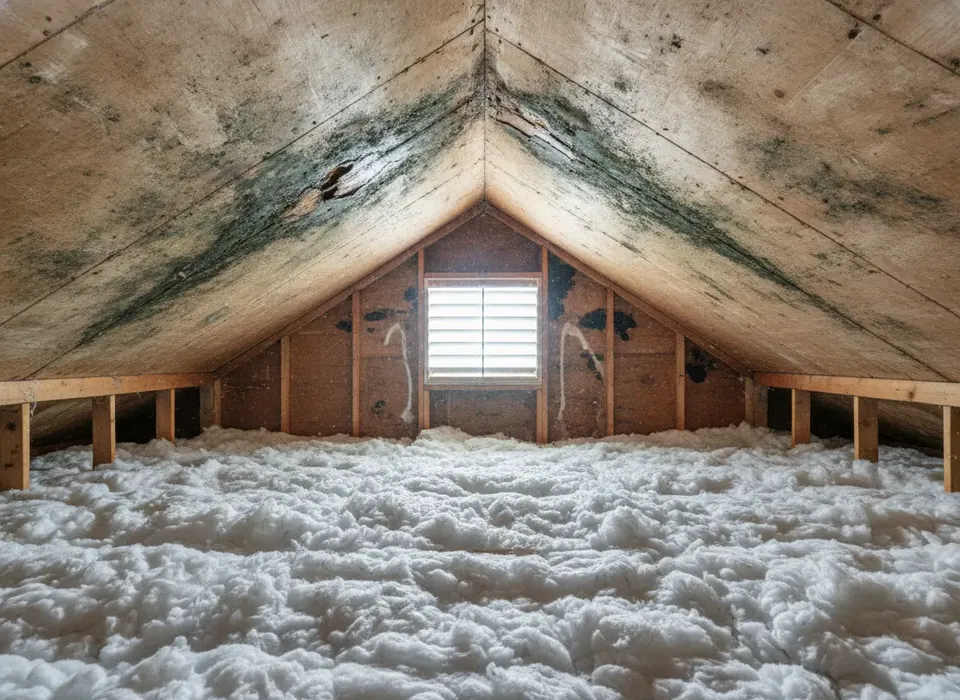
- Signs in the attic: dark streaks or spotting on the underside of the decking following a rafter bay, wet or discolored insulation below it, daylight at a flashing.
- Who fixes it: a roofer, and in Plano a roof replacement needs a city permit pulled by a registered contractor. The mold job is separate.
Source 2: the attic air handler and its condensate line
Slab-on-grade homes, which is nearly every home in Plano, have no basement, so the furnace and evaporator coil often go in the attic. In July and August the unit runs most of the day and night, pulling gallons of water out of the air through a primary condensate drain. When that line clogs with algae and the secondary pan has rusted through or its float switch is missing, the overflow lands on the ceiling drywall and the insulation below. A frozen coil does the same when it thaws. The wet patch comes and goes with the AC cycle, which is why it fools people: it dries out in October and the stain seems to stop growing.
- Signs: a ceiling stain directly under the air handler or along the duct run, water dripping from the secondary drain line at an exterior eave (that pipe is a warning, not a feature), a musty smell when the AC starts.
- Who fixes it: a state-licensed air conditioning contractor clears or repairs the drain, pan and float switch. Installing or replacing an AC system in Plano needs a permit. Texas rules also limit the use of biocides and antimicrobial coatings inside HVAC systems to specific conditions (16 TAC 78.130), so be wary of anyone offering to spray the ductwork.
- Insurance note: most insurers treat a neglected condensate drain as maintenance, not a sudden loss.
If the growth has reached the ducts or the coil, see HVAC, duct and AC mold in Plano.
Source 3: bathroom fans and dryer vents that end in the attic
Builders are supposed to run bath exhaust ducts through the roof or a gable. In plenty of 1980s and 1990s Plano houses the flexible duct stops short, or has fallen off its roof jack, and every shower sends warm, wet air straight into the insulation. In winter that air hits a roof deck that is colder than the dew point and condenses; the mold pattern sits in a cone around the duct end. A dryer vent that disconnects in the attic does the same with lint added.
This one is cheap to fix and often found during the assessment: reconnect or extend the duct to a proper roof or wall termination, and check that the fan actually moves air.
How a Texas attic mold job works
Licensed assessment
A TDLR-licensed mold assessment consultant inspects the attic, reads moisture in the decking and ceiling, traces the source and writes a remediation protocol if the growth is at or near 25 contiguous square feet. The protocol sets the scope, containment and clearance criteria. See mold inspection and testing.
Fix the water first
Roofer, AC contractor or a duct reconnection. Remediation before the source is fixed is money spent twice.
Remediation per protocol
A separate TDLR-licensed remediation company notifies TDLR at least five days before starting a 25-plus square foot job, sets containment, runs HEPA filtration, removes contaminated insulation and cleans the decking as the protocol specifies. Rotted structural wood is a carpentry item.
Clearance and certificate
The assessor returns to confirm the work passed clearance. Within 10 days you receive the Certificate of Mold Damage Remediation (TDI form MDR-1). Ask for it by name; it protects you with insurers and future buyers.
Rebuild
New insulation is usually in the quote; ceiling drywall and any roof or HVAC work go to the trades, with permits where the city requires them.
What attic mold costs
| Item | Typical published range | Source |
|---|---|---|
| Attic mold remediation | $1,000 to $4,000 | This Old House 2026 |
| Remediation, per sq ft | $10 to $25 (avg about $18) | This Old House 2026; Fixr 2025 |
| Licensed assessment and protocol | $303 to $1,044 (avg about $670) | HomeAdvisor 2025 |
| Air-sample lab fees, if sampled | $250 to $350 | HomeAdvisor 2025 |
| TDLR notification fee (25+ sq ft) | $25 | TDLR |
Typical published ranges, not quotes (Fixr Aug 2025, This Old House Mar 2026, HomeAdvisor 2025). Plano quotes come from the companies, not from this site. Roof, HVAC and drywall work are extra.
Access is the main cost driver in attics. The full breakdown, with a calculator, is in the Plano mold remediation cost guide.
Insurance and the slow leak. Hail damage to the roof is usually a covered peril. The slow leak that followed it for months is where claims get argued, and mold remediation on top is often capped or excluded unless your policy carries a mold endorsement. Photograph the attic before anyone touches it, keep the roofer's report, and report the loss promptly. More in does homeowners insurance cover mold in Texas.
Before you hire, verify the TDLR license at tdlr.texas.gov/LicenseSearch, confirm the assessment and remediation come from separate companies, and ask for the Consumer Mold Information Sheet, the written protocol and proof of $1 million liability insurance. In a home built before 1978, ask whether the drywall work is done by an EPA Lead-Safe Certified firm and whether old ceiling texture should be sampled for asbestos first; roughly one in six Plano homes predates 1980, so these are questions, not blanket requirements. And if a storm-chasing roofer has you sign at the door, Texas gives you until midnight of the third business day to cancel.
Frequently asked questions
Why is there mold on my attic roof decking?
Dark staining on the underside of the roof decking almost always follows water from above: hail-bruised shingles, lifted flashing around a vent or chimney, or a nail pop. A bath fan or dryer duct venting into the attic can produce the same pattern near the duct end. A roofer finds the leak; a licensed mold assessor maps how far the moisture and growth extend.
Does homeowners insurance cover attic mold from a hail-damaged roof?
Wind and hail are typically covered perils, and mold that follows a covered roof loss is often handled as ensuing damage, subject to any mold limit in the policy. A slow leak that went unreported for months is where insurers push back. Report hidden losses promptly, since many Texas policies require notice within 30 days of discovery, and never assume coverage until your insurer confirms it.
How much does attic mold remediation cost?
This Old House's 2026 published range for attic mold remediation is $1,000 to $4,000, with general remediation at $10 to $25 per square foot. A licensed assessment adds roughly $303 to $1,044. Roof repair, HVAC work and replacing insulation are separate trades and separate bills. Plano quotes come from the companies, not from this site.
Do I need a permit in Plano for attic mold work?
Mold cleanup itself usually needs no City of Plano permit. Replacing the roof, installing or replacing an air conditioning system or furnace, and plumbing work do require permits, pulled by contractors registered with the city. Confirm with Plano Building Inspections, and check with your own city if you are in Frisco, Allen, McKinney or elsewhere in Collin County.
Get quotes for attic mold in Plano and Collin County
Tell the companies where the staining is, whether the roof has been repaired or claimed, and where the air handler sits. Independent, TDLR-licensed Texas assessment and remediation companies serving Plano, Frisco, Allen, Wylie, McKinney and nearby towns will reply with free quotes. Request a free quote or call (972) 472-8749. Details on the service are at attic and roof leak mold.