
Bathroom & Ceiling Mold Removal in Plano, TX
Spots on the shower ceiling, a black line along the tub, a ring on the ceiling under the AC. Some of it you can clean yourself; some of it means water behind the wall. Free quotes from independent, TDLR-licensed companies.
Get a Free Quote Call (972) 472-8749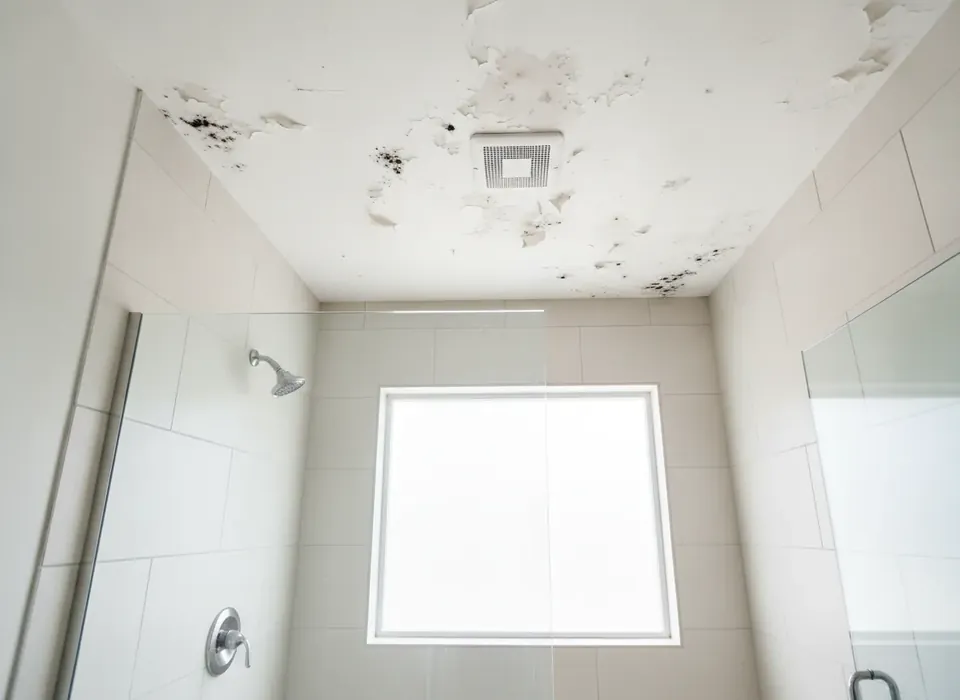
Surface mold or water behind the wall?
Bathroom and kitchen mold is the most common mold problem in Plano homes and usually the smallest. The first question is whether the water came from the room's air or from behind the surface.
Air moisture is the easy case. A hot shower in a bathroom whose fan is weak, missing or venting into the attic leaves the ceiling wet for an hour every morning. In summer the humid outdoor air makes it worse, and in a closed-up guest bath the ceiling never fully dries. The mold sits on the paint film. Many Plano homes from the 1970s and 1980s have small, poorly vented baths; ceilings in those rooms are the classic case.
Water from behind is the other case. A failed shower pan, a cracked grout line, a dripping supply stop under the sink, a toilet wax ring, a dishwasher line, or the air handler in the attic above a hall bath. Those feed drywall and framing from the back, and the stain you see is the last place the water reached.
A good rule: if the spots wipe off and stay off, it was the air. If they come back, the paint bubbles or the drywall is soft, get a licensed assessment.
Under 25 square feet: the DIY option
Texas law does not require a licensed company for areas under 25 contiguous square feet, which is most bathroom ceilings. The EPA's guidance for small areas is plain: wear gloves, eye protection and an N95, scrub hard surfaces with detergent and water, dry them fully, and fix the moisture. Porous material like drywall with growth through the surface is generally removed rather than cleaned.
- Run the exhaust fan during and for 20 minutes after every shower. If it cannot hold a square of toilet paper to the grille, it is too weak.
- Check where the fan duct goes. In many 1970s to 1990s homes it ends in the attic, which moves the mold problem upstairs.
- Keep indoor humidity under 60 percent; the EPA's ideal is 30 to 50 percent. In a Plano summer that means the AC must be running and draining properly.
- Skip bleach on drywall; TDLR says it is not a permanent solution without fixing the water.
- Repaint with a mildew-resistant bathroom paint after the surface is clean and dry.
If you start a DIY job and uncover 25 square feet or more behind the surface, Texas rules say stop and bring in licensed companies; the exemption is lost at that point.
What the companies do when it is bigger
Assessment
A TDLR-licensed assessor meters the ceiling, the wall behind the tile and the floor around the toilet and tub, and names the source. For 25 square feet or more they write the protocol.
Stop the water
A plumber replaces the pan, valve or supply; an HVAC contractor clears the condensate line above a ceiling stain. Plumbing work in Plano needs a permit from a registered contractor.
Containment and removal
The bathroom is sealed, a HEPA scrubber runs, and stained drywall, backer board, vanity base or subfloor comes out. Tile that must be removed to reach the wall is a separate rebuild cost.
Dry, clear, certify
Framing is dried to target, the assessor clears it, and the Certificate of Mold Damage Remediation arrives within 10 days.
Rebuild
Drywall, texture, paint, tile. In pre-1978 homes, ask about lead-safe practices and whether 1970s to 1980s ceiling texture or sheet flooring should be sampled for asbestos first.
What bathroom and ceiling mold removal costs
Most bathroom jobs are small. Tile tear-out and shower rebuilds are what push them up.
| Item | Typical range | Source |
|---|---|---|
| Bathroom | $500–$1,500 | Fixr 2025 |
| Mold remediation, per sq ft | $10–$25 (avg ≈ $18) | This Old House 2026; Fixr 2025 ($10–$30) |
| Small area ≈ 50 / 100 / 200 / 500 sq ft | $500–$1,250 / $1,000–$2,500 / $2,000–$5,000 / $5,000–$12,500 | This Old House 2026 |
| Mold inspection / testing (licensed assessor, separate company) | $303–$1,044 (avg ≈ $670); air-sample lab fees $250–$350 | HomeAdvisor 2025 |
| TDLR notification fee (25+ sq ft jobs) | $25 | TDLR |
Typical published ranges, not quotes (Fixr Aug 2025, This Old House Mar 2026, HomeAdvisor 2025). Plano quotes come from the companies, not from this site.
Kitchens follow the same per-square-foot logic, with cabinet removal as the extra. The cost guide covers what is and is not in a mold quote.
Kitchens, ceilings and renters
Kitchens. The under-sink cabinet, the dishwasher, the refrigerator line and the wall behind the range are the usual spots. Particleboard cabinet floors swell and grow mold quickly; they are replaced, not cleaned.
Ceilings elsewhere. A stain on a hall or bedroom ceiling is usually the attic air handler or a roof leak; see the attic page and the HVAC page. A first-floor ceiling under an upstairs bath is a plumbing leak until proven otherwise.
Renters. A moldy bathroom from a leak or failed fan is the landlord's repair. Put the request in writing; under Property Code 92.052 a landlord must make a diligent effort to repair a condition affecting health or safety once notified, if rent is current. See the apartment page. Not legal advice.
Insurance. A burst supply line is usually a sudden and accidental event; a shower pan that has leaked for a year is a continuous leak, which Texas policies generally exclude. Many policies cap or exclude mold remediation unless endorsed. Never count on coverage.
Questions to ask the companies
- Is this under or over 25 square feet, and does it need a licensed assessment?
- Where is the water coming from, and who fixes that?
- Will tile or the shower pan have to come out, and is rebuild quoted separately?
- Will the bathroom be contained with a HEPA scrubber running?
- License number, Consumer Mold Information Sheet and proof of insurance?
Get bathroom and ceiling mold quotes in Plano
Tell us which room, how big the spots are, and whether the fan works and where it vents. We pass it to independent, TDLR-licensed companies, and they reply with quotes.
Independent, TDLR-licensed Texas companies reply to you directly. No obligation, and you choose who to hire. Prefer to talk? Call (972) 472-8749
Bathroom and ceiling mold questions
Can I clean bathroom ceiling mold myself?
Usually. Texas does not require a licensed company under 25 contiguous square feet, and the EPA says small areas can be cleaned with detergent and water while wearing gloves, eye protection and an N95. Dry it, run the fan and repaint with mildew-resistant paint. If spots return within weeks, the paint bubbles or the drywall is soft, the water is behind the surface and the job is bigger than the stain.
Does bleach kill mold on drywall?
TDLR's consumer sheet says applying bleach without removing the moisture source is not a permanent, effective solution, and painting over mold does not work either. Bleach is mostly water, which soaks into porous drywall and can feed the next round. On hard, non-porous surfaces a detergent clean is the EPA's recommendation. On drywall that is stained through, removal is the fix.
Why is there mold on the ceiling under my upstairs AC?
In most two-story Plano homes the air handler sits in the attic above a hall or bathroom. A clogged condensate line, a rusted secondary pan or a frozen coil drips onto the ceiling drywall. The stain grows in a ring and the mold follows. An HVAC contractor fixes the drain; a mold company handles the ceiling. See the attic and HVAC pages for both halves.
How much does bathroom mold remediation cost?
Fixr's 2025 range for a bathroom is $500 to $1,500, and a surface-only job can be less. If the shower pan has failed or the wall behind the tile is wet, tear-out and rebuild push the number far higher and the tile work is a separate trade. At 25 square feet or more, add a licensed assessment, protocol and clearance from a separate company. Quotes come from the companies.
Do I need a licensed company for a small bathroom job?
Not under 25 contiguous square feet; you can clean it or hire a handyman. If you do hire a TDLR-licensed company for a small job, the rules still require it to follow a protocol and work plan, though no TDLR notification is needed. If anyone opens the wall and finds 25 square feet or more, the exemption is lost and licensed companies must finish the work.
Seeing or smelling mold? Get a clear plan.
Free, no-pressure quotes from independent Texas-licensed companies across Plano, Frisco, McKinney, Allen and Collin County.