
HVAC, Duct & AC Mold Removal in Plano, TX
A musty blast when the AC kicks on, growth on the coil or in the drain pan, dark dust at the supply registers. Independent, TDLR-licensed companies reply with free quotes for assessment and remediation of the system.
Get a Free Quote Call (972) 472-8749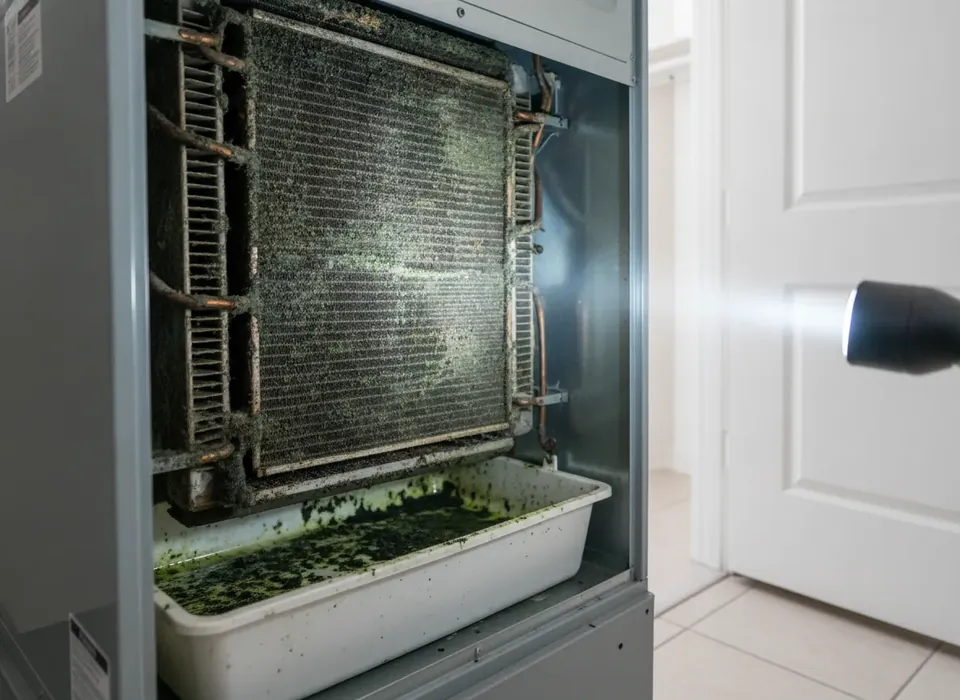
Why AC systems grow mold in Plano
North Texas air conditioning runs for roughly five months without a real break. July and August nights at DFW stay near 76 degrees, so the system never gets the cool, dry stretch that would let the coil dry out. The evaporator coil is wet by design; the drain pan under it holds water; the insulated supply plenum right after the coil is cool and damp. Add dust for food and you have the usual spot.
Plano's slab-on-grade two-story homes put the air handler in the attic, where it sits in 120-degree air at outdoor dew point. A clogged primary condensate line, a rusted secondary pan or a tripped-but-ignored float switch means standing water in the cabinet. Leaky supply ducts pull humid attic air into the system, and a unit that is oversized short-cycles and never runs long enough to dehumidify the house, so indoor humidity drifts above the EPA's 60 percent line even with the thermostat satisfied.
Older east Plano homes often have the unit in a hall closet and original internally lined ductwork that holds moisture.
If the leak has stained the ceiling below the unit, see attic mold.
How an HVAC mold job runs in Texas
Texas treats HVAC mold remediation as its own case. Rule 16 TAC 78.130 applies all of the general remediation requirements to HVAC systems and adds limits on what can be sprayed or coated inside them. Two licensed companies are still involved, and the mechanical repair is a third trade.
Licensed assessment
A TDLR-licensed assessor inspects the coil, pan, blower, plenum and a sample of ducts, meters the cabinet and surrounding drywall, and may take surface or air samples. At 25 contiguous square feet or more across the system, they write the protocol.
Fix the cause
A TACL-licensed AC contractor clears or re-routes the condensate line, replaces the pan, installs a working float switch, seals duct leaks or corrects a frozen coil. Replacing the system needs a Plano permit from a registered contractor.
Shut down and contain
The system is turned off, registers are sealed and the work area around the air handler is contained with a HEPA scrubber running.
Clean or replace components
Hard components such as the coil, pan, blower housing and sheet-metal plenum are cleaned and HEPA vacuumed. Porous items such as internally lined duct, flex duct with growth, and fiberglass duct board generally cannot be cleaned and are removed and replaced.
Biocides and coatings, only by the rules
Any antimicrobial or coating inside the system must meet 78.120(h): named in the protocol, safety data sheet delivered to you, your agreement on record, occupants notified.
Clearance and certificate
The assessor clears the system per the protocol, and the Certificate of Mold Damage Remediation follows within 10 days.
Signs it is the HVAC system
- The musty smell is strongest for the first minute after the AC starts, then fades.
- Dark fuzzy dust on the supply registers or the ceiling around them.
- Water stains on the ceiling under the attic unit, or in the closet around a downstairs unit.
- The indoor humidity reads above 60 percent while the house is cool.
- Growth visible on the coil or in the pan when the service panel is opened.
A humidity reading is the cheapest diagnostic you can run. A $15 hygrometer that reads 60 percent or more in July means the system is not dehumidifying, whether or not you can see growth yet. The EPA's target is 30 to 50 percent.
What HVAC and duct mold remediation costs
System jobs are among the pricier categories because they touch the whole house and often mean duct replacement.
| Item | Typical range | Source |
|---|---|---|
| HVAC / ducts | $3,000–$10,000 | Fixr 2025 |
| Mold remediation, per sq ft | $10–$25 (avg ≈ $18) | This Old House 2026; Fixr 2025 ($10–$30) |
| Mold inspection / testing (licensed assessor, separate company) | $303–$1,044 (avg ≈ $670); air-sample lab fees $250–$350 | HomeAdvisor 2025 |
| TDLR notification fee (25+ sq ft jobs) | $25 | TDLR |
Typical published ranges, not quotes (Fixr Aug 2025, This Old House Mar 2026, HomeAdvisor 2025). Plano quotes come from the companies, not from this site.
These exclude the AC repair or replacement, which is a separate HVAC quote, and any ceiling or drywall removal below a leaking unit. See the cost guide for the Texas four-part structure.
Licenses, permits and what to ask
Two licenses, three trades. The mold assessment company and the mold remediation company each hold a TDLR mold license, and by law they are different businesses on your project. The AC repair goes to a contractor licensed under Occupations Code chapter 1302. Verify all three at tdlr.texas.gov/LicenseSearch. Plano Mold Experts holds no license and does no work.
Permits. Cleaning the system needs no Plano permit. Installing or replacing an air conditioning system or a furnace does, by a city-registered contractor. Confirm with Plano Building Inspections; Frisco, McKinney, Allen and Richardson issue their own.
Insurance. A condensate line that has dripped for a season is a continuous leak, which Texas policies generally exclude, and many policies cap or exclude mold remediation unless endorsed. A sudden event, such as a pan that failed overnight and flooded a ceiling, is more often covered as water damage. Report hidden losses within 30 days of discovery, and do not count on coverage.
Questions to ask the companies
- Are you quoting duct cleaning or licensed mold remediation under 16 TAC 78.130?
- Which components will be cleaned, and which ducts replaced?
- Will any biocide or coating be used, and will I get the safety data sheet and consent form?
- Who is the separate licensed assessor, and will clearance include the ducts?
- Who fixes the condensate drain or coil, and is that contractor TACL-licensed?
- License number, Consumer Mold Information Sheet and proof of $1 million liability insurance?
Get HVAC and duct mold quotes in Plano
Tell us where the unit is, what you see or smell, and whether the condensate line has backed up. We pass it to independent, TDLR-licensed companies, and they reply with quotes.
Independent, TDLR-licensed Texas companies reply to you directly. No obligation, and you choose who to hire. Prefer to talk? Call (972) 472-8749
HVAC, duct and AC mold questions
Can mold in my AC spread through the whole house?
The air handler moves all the air in the house several times an hour, so growth on the coil, in the pan or in the supply plenum reaches every room. That is why HVAC mold is treated as a system problem, and why the companies check the return side, the plenum and the ducts, not only the visible spot. The EPA's advice is to fix the moisture source first.
Is duct cleaning the same as mold remediation?
No. Duct cleaning is a maintenance service that vacuums dust from the ducts. Mold remediation of an HVAC system in Texas is covered by 16 TAC 78.130, which applies the full remediation rules, requires a licensed assessor's protocol on 25-plus square foot projects, and limits what biocides and coatings may be applied inside the system. Ask which service you are being quoted.
Who fixes the AC itself?
A licensed air conditioning contractor. Texas licenses AC and refrigeration contractors under Occupations Code chapter 1302 through TDLR's TACL program, and Plano requires a permit from a registered contractor to install or replace an AC system or furnace. The mold companies clean and remove; they do not repair the coil, the drain or the ductwork.
How much does HVAC mold remediation cost?
Fixr's 2025 range for HVAC and duct remediation is $3,000 to $10,000, with This Old House putting a furnace or air handler at $3,000 to $5,000 and a full central system up to $10,000. Replacing flexible duct that cannot be cleaned, the AC repair, and the separate licensed assessment and clearance are on top. Plano quotes come from the companies.
Can antimicrobial sprays or coatings be used inside my ducts?
Only under conditions the rules set. 16 TAC 78.130 limits biocides and antimicrobial coatings in HVAC systems to the conditions in 78.120(h): the product must be named in the protocol, you receive its safety data sheet and agree to it, and occupants are notified. A company that proposes fogging the system without those steps is not following the Texas rules.
Seeing or smelling mold? Get a clear plan.
Free, no-pressure quotes from independent Texas-licensed companies across Plano, Frisco, McKinney, Allen and Collin County.