
You found mold behind a baseboard or on a ceiling and want to know whether insurance will pay. In Texas the honest answer is "sometimes, and only for part of it." This guide explains the policy language the Texas Department of Insurance (TDI) describes, what the 2002 mold endorsements changed, and what to do in the first few days so your claim is not denied on a technicality.
Plano Mold Experts is a free quote service. We connect Plano and Collin County homeowners with independent, TDLR-licensed Texas mold assessment and remediation companies. We are not an insurer, an adjuster or a law firm, and nothing here is a promise of coverage.
The short answer: it turns on how the water got there
TDI's homeowners insurance guide, updated in June 2026, puts it plainly. Most policies cover the sudden and accidental release of water. Most do not cover a continuous water leak. And most do not pay to remove mold, except as needed to repair damage from a covered risk. Companies commonly sell a mold removal endorsement for people who want more.
So the question is never "do I have mold?" It is "what caused the water, was that covered, and does my policy limit mold work on top?"
| What happened | How insurers usually treat it | Mold work |
|---|---|---|
| Supply line bursts in a wall or attic; water appears within hours | Sudden and accidental; the water damage is often covered | Often covered only as part of repairing the covered damage, subject to any mold limit |
| Pipe froze and split during a winter storm | Usually sudden and accidental if the home was heated or reasonably protected | Same as above; policies may ask whether you took steps to prevent freezing |
| Hail opens the roof; a storm soaks the attic | Wind and hail are typically covered perils | Mold that follows a covered roof loss is often handled as ensuing damage, subject to limits |
| Slow slab leak or drip under a sink over months | Continuous or repeated leakage; commonly excluded | Usually not covered |
| Condensation, high indoor humidity, a bathroom with no exhaust fan | Maintenance and neglect; excluded | Not covered |
| Rising water from a creek or street | Flood; excluded from homeowners policies, separate flood insurance applies | Not covered under the homeowners policy |
General patterns described by TDI and common Texas policy forms. Your policy controls, and only your insurer can tell you what it will pay.
What changed in 2002: the mold exclusion endorsements
After a wave of mold claims around 2001, TDI approved endorsements that insurers could attach to Texas homeowners policies, and their language still shapes most policies sold here. In plain terms, they say:
- The policy does not cover loss caused by or resulting from mold, fungi or other microbes.
- It does cover ensuing mold losses caused by a sudden and accidental discharge, leakage or overflow of water, if that water loss is itself covered.
- Hidden losses must be reported no later than 30 days after you detect, or should have detected, the loss.
- The cost of remediation, including testing of ensuing mold, is not covered unless you bought a mold endorsement.
Insurers were then allowed to sell optional buy-back endorsements with their own limits. There is no statutory cap; each policy sets its own number, and many policies cap or exclude mold remediation unless endorsed.
Where to look. Pull your declarations page and the list of endorsements and search for "mold," "fungi" and "microbes." An exclusion with no buy-back endorsement means remediation and testing are on you, with only the covered water damage repair in play. A mold endorsement will state a dollar limit; that is usually the most the insurer will pay for mold work regardless of cause.
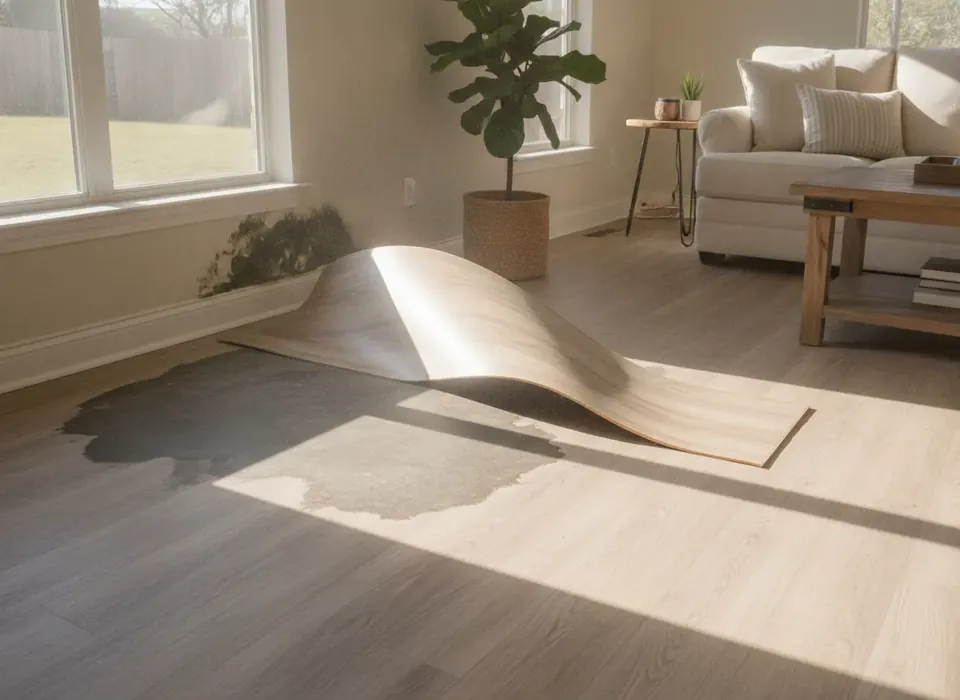
Why Plano claims so often land in the grey zone
Plano's housing stock and climate produce exactly the losses insurers argue about.
- Slab leaks. Nearly all homes here sit on slabs over Blackland Prairie clay that shrinks and swells with the seasons, and plumbers in Plano report that under-slab lines in 1970s and 1980s homes fail regularly. A slab leak can run for weeks before a warm floor or a high water bill gives it away, which is why "when did it start?" becomes the whole claim.
- Winter Storm Uri. In February 2021, DFW stayed below freezing for 139 straight hours and Plano took more than 300 emergency shutoff calls in three days as pipes burst. Those were sudden losses, but a wall that was dried quickly and closed up can still hold mold five years later, and a new claim for it now faces the 30-day reporting language.
- Hail roofs. The April 11, 2016 storm hit Plano, Wylie, Frisco and Allen. Hail-bruised shingles leak slowly for months before a stain appears. The roof loss is sudden; the slow leak that followed is where adjusters push back. A clogged attic AC drain is in the same category: maintenance in most insurers' eyes.
What to do in the first 48 hours
Stop the water and start drying
Shut off the supply, tarp the roof, or call a plumber. EPA says wet materials should be dried within 24 to 48 hours. Insurers expect you to prevent further damage; do not wait for an adjuster before drying.
Document everything before cleanup
Photograph the source, the water path, the damaged materials and any mold. Keep the failed pipe section or shingle if you can, and save plumber and roofer invoices; they describe the cause, which is what the claim turns on.
Report promptly
Call your agent or the claims line and note the date. Hidden losses in many Texas policies must be reported within 30 days of discovery. Say what you know; do not guess at how long the leak has been there.
Get a licensed assessment
At or near 25 contiguous square feet, Texas requires a licensed mold assessment consultant to write a remediation protocol before a licensed remediator starts. That protocol doubles as the scope document your adjuster will want. See mold inspection and testing in Plano.
Ask for the Certificate of Mold Damage Remediation
The remediator must hand you the certificate (TDI form MDR-1) within 10 days of finishing. Give a copy to your agent: under Insurance Code 544.303 an insurer may not use remediated mold damage shown on it against you in underwriting.
What you pay when insurance does not
If the cause is excluded or the mold limit is small, the rest comes out of pocket. Published national ranges give a planning figure: $10 to $25 per square foot for remediation, a typical whole job between $1,500 and $9,000 (Fixr 2025, This Old House 2026), and a licensed assessment at about $303 to $1,044 (HomeAdvisor 2025). The Plano mold remediation cost guide breaks the Texas four-part structure down and has a calculator. Quotes come from the companies, not from this site.
Remember that the plumbing, roofing or foundation repair is a separate trade and a separate line on the claim, and that your deductible applies to the whole loss. Whoever quotes the work, verify the TDLR license at tdlr.texas.gov/LicenseSearch and ask for the Consumer Mold Information Sheet, proof of $1 million liability insurance and the written protocol before anything starts.
Frequently asked questions
Does Texas homeowners insurance cover mold from a slab leak?
It depends on how the leak is classified. A pipe that bursts under the slab and floods a room is usually treated as a sudden and accidental discharge, and the resulting water damage is often covered. A pinhole leak that has been seeping for months is usually treated as a continuous leak, which most policies exclude. Even when the water loss is covered, mold removal itself is often capped or excluded unless the policy carries a mold endorsement. Read your declarations page and ask your agent.
How much mold coverage do Texas policies include?
There is no single statewide number. Since TDI approved mold exclusion endorsements in 2002, many Texas policies exclude mold remediation and testing unless you bought a mold endorsement, and those endorsements set their own limits. Some policies cap mold remediation at a few thousand dollars; others offer higher optional limits. The only reliable source is your own policy and its endorsements.
How long do I have to report mold to my insurer in Texas?
Report any water loss as soon as you find it. The TDI-approved endorsement language used in many Texas policies says a hidden loss must be reported no later than 30 days after you detect it or should have detected it. Waiting also gives the insurer an argument that the damage came from a continuous leak or neglect rather than a sudden event.
Will a mold claim raise my rates or get my policy cancelled?
Texas Insurance Code 544.303 says an insurer may not make an underwriting decision on a residential policy based on previous mold damage or a mold claim when the property was remediated and a Certificate of Mold Damage Remediation was issued, or an independent assessor found no evidence of mold damage. That is why the certificate matters. Rates depend on many factors, so no website can promise your premium will not change.
Need quotes to send to your adjuster?
Describe the water source, the rooms affected and roughly how much mold you see, and independent, TDLR-licensed companies serving Plano, Frisco, McKinney, Allen and the rest of Collin County will reply with free quotes. Request a free quote or call (972) 472-8749. We share your request with matched companies; we do not do the work and cannot speak for your insurer.