
How a Texas Mold Job Works, from Quote to Certificate
Plano Mold Experts is a free quote service, not a mold company. You describe the problem once; independent, TDLR-licensed Texas mold assessment and remediation companies reply with free, no-obligation quotes. Here is our part, and the ten steps a licensed mold job in Plano follows under Texas rules.
Get a Free QuoteOur part: getting you quotes
This site does not inspect, test or remediate anything and holds no license. The companies you choose do the work and contract with you directly.
You describe the problem
Fill out the free quote form or call. Where you see or smell mold, the rough size, what got wet and when, the age of the house. Photos help later. Nothing has to be exact.
Independent licensed companies reply
Your request goes to TDLR-licensed assessment and remediation companies that serve your area, from Plano to Frisco, Richardson and Wylie. They contact you directly. Some pay a fee to receive requests; that is how the site is funded.
You compare and decide
Compare written protocols and scopes with the cost guide, verify each license, hire or walk away. Free, no obligation.
Why Texas jobs have two companies
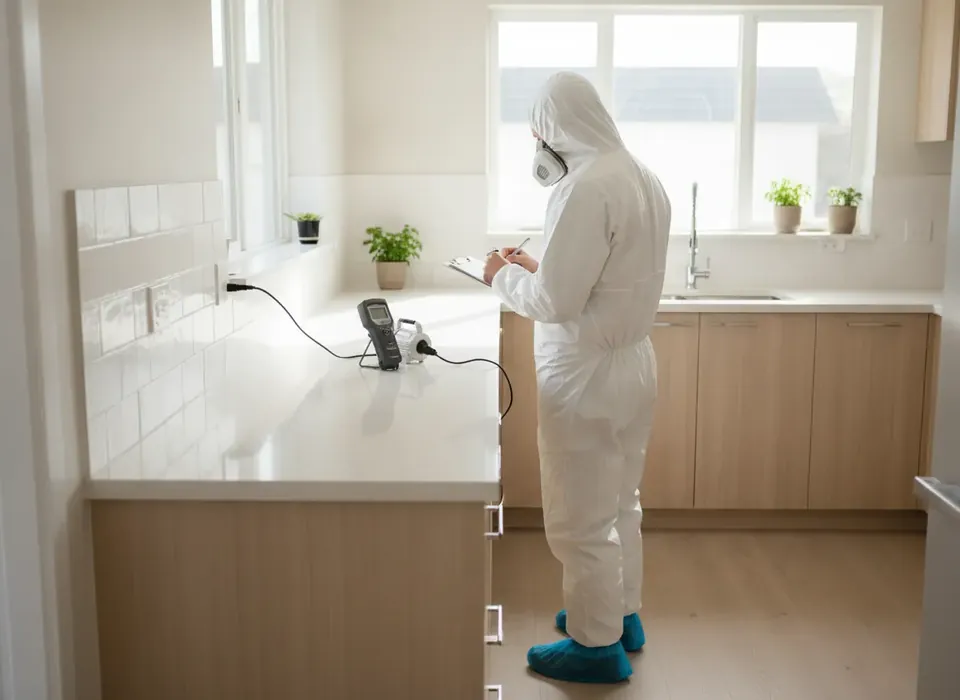
Texas licenses mold work under Occupations Code chapter 1958 and the TDLR rules in 16 Texas Administrative Code chapter 78. Assessment (inspecting, sampling, writing the protocol, clearing the job) and remediation (removing the mold) are separate licenses, and section 1958.155 bars one license holder, or two businesses with a common owner, from doing both on the same project.
The result is a built-in second opinion. The company that decides what needs to come out and whether the job passed is not the company being paid to do the removal. A homeowner can get quotes from both kinds of company through this site, but no company does both for you.
The rules apply to hired work at 25 contiguous square feet or more. Under that, a homeowner may clean the mold or hire anyone, and the steps below are optional. If an unlicensed job uncovers 25 square feet or more, the exemption is lost, the work must stop and licensees finish it.
The ten steps of a licensed mold job in Plano
Based on the TDLR rules and EPA guidance. The order is set by law; the pace depends on the water source and the size of the job.
Describe the problem once
Use the free quote form or call. Say where the mold is, roughly how big it looks, what got wet and when, the age of the house, and whether it is a house, apartment or business. Independent, TDLR-licensed Texas mold assessment and remediation companies that serve your ZIP code reply with free, no-obligation quotes.
Licensed assessment and moisture mapping
A licensed mold assessment consultant inspects the area, reads moisture in walls, floors and framing, and traces the water to its source: a slab leak, an attic condensate line, a hail-damaged roof, a burst pipe or a bath fan venting into the attic. Samples go to a TDLR-licensed lab only if they add information; TDLR says species testing is usually unnecessary.
Written remediation protocol
The consultant writes a protocol specific to your project: rooms and areas, estimated quantities of material, methods for each area, protective equipment, containment type and the clearance criteria. You receive it at least one calendar day before remediation begins.
TDLR notification
For 25 or more contiguous square feet, the remediation contractor notifies the Texas Department of Licensing and Regulation at least five days before starting, with a $25 fee. In a water-damage emergency where delay would increase contamination, notice is due by the next business day.
Containment and negative air
The contractor's work plan is delivered at least a day before preparation starts. Plastic containment with HEPA-filtered negative air keeps spores inside the work zone, and yellow notice signs go on every accessible entrance.
Removal per protocol
Workers remove and bag porous moldy material such as drywall, insulation and carpet pad, clean non-porous surfaces such as framing and concrete, and HEPA-vacuum the area. Any biocide use in HVAC systems follows the separate Texas rule for those systems.
Drying
Air movers and dehumidifiers bring framing and the slab back to dry readings. The EPA notes that wet materials dried within 24 to 48 hours usually do not grow mold, so drying is also how the job keeps mold from returning.
Clearance assessment by the assessor
While containment is still up, the assessment consultant returns and checks visually, procedurally and, if the protocol says so, with samples. The consultant confirms the area is free of visible mold and wood rot, that the work followed the protocol and that the water cause was addressed, then issues a written passed clearance report.
Certificate of Mold Damage Remediation within 10 days
No later than 10 days after completion, the contractor gives the property owner the Certificate of Mold Damage Remediation on TDI form MDR-1, signed by the consultant and the contractor, along with before and after photos. Keep it with your insurance papers; sellers must give buyers copies for five years.
Rebuild by registered contractors
New drywall, texture, paint and flooring go in after clearance. Mold cleaning itself usually needs no Plano permit, but replacing walls, plumbing, HVAC or roofing does, pulled by a contractor registered with the city. Confirm with Plano Building Inspections or your own city's building department.
Before you hire: what to ask
Every company that quotes a 25+ square foot job in Texas should be able to show you these without hesitation:
- The TDLR license number for the company and the individual, checked at tdlr.texas.gov/LicenseSearch. Unlicensed assessment or remediation carries a $2,000 to $5,000 penalty per violation, and up to $5,000 per day under Occupations Code 51.302.
- The Consumer Mold Information Sheet from TDLR, which licensees must give you at first contact or at least a day before work.
- Proof of at least $1 million in commercial general liability insurance, which the rules require licensees to carry.
- The written protocol (from the assessor) and the work plan (from the contractor), including the clearance criteria.
- Confirmation that the assessor and the contractor are different businesses with different owners.
- For a pre-1978 home, whether the firm is EPA Lead-Safe Certified; for 1970s and 80s texture or flooring, whether asbestos sampling makes sense before tear-out.
- Whether the quote includes rebuild and the water fix, or whether those are separate contractors and permits.
- A commitment to deliver the Certificate of Mold Damage Remediation (TDI form MDR-1) within 10 days.
If a company came to your door after a storm, Texas gives you until midnight of the third business day to cancel a contract signed at home (Business and Commerce Code chapter 601). This is general information, not legal advice.
How long it takes and whether you have to move out
Timelines come from the companies, not from this site, and no company can promise a date before seeing the job. In broad terms, the assessment visit is usually a single appointment, lab results take days rather than hours, the protocol follows the results, and the five-day TDLR notice sets the earliest start unless the job qualifies as an emergency. Removal of a single wall section is often a few days of work plus drying; whole-room or whole-house jobs run longer. Clearance happens after drying, and the certificate follows within 10 days.
Containment usually lets the rest of the house stay occupied. Jobs that take the kitchen or the only bathroom offline, or that involve the air handler, are the ones where families sometimes choose to stay elsewhere. Ask each company how it will keep the work zone sealed and what rooms you can use.
Ready to start? Read the FAQ, check the cost guide, or request free quotes.
Seeing or smelling mold? Get a clear plan.
Free, no-pressure quotes from independent Texas-licensed companies across Plano, Frisco, McKinney, Allen and Collin County.