
Search for mold help in Plano and you will see "inspection," "testing," "assessment" and "air quality test" used as if they were the same service. They are not, and the difference affects what you pay and what you get. This guide separates them, explains how Texas licensing fits, and lists the handful of situations where lab testing is worth the money.
Plano Mold Experts is a free quote service. The companies we connect you with are independent, TDLR-licensed Texas mold assessment and remediation companies. We do not inspect, test or remove mold ourselves. Quotes are free; the assessment and the work are paid services from the companies.
Inspection, testing and assessment: three words, two services
Texas law uses one umbrella term. Occupations Code 1958.001 defines mold assessment as an inspection, investigation or survey of a building to find or evaluate mold, to develop a remediation protocol, or to collect and analyze a sample. Only a holder of a TDLR mold assessment license may do any of that for hire. In everyday language:
| Mold inspection | Mold testing (sampling) | |
|---|---|---|
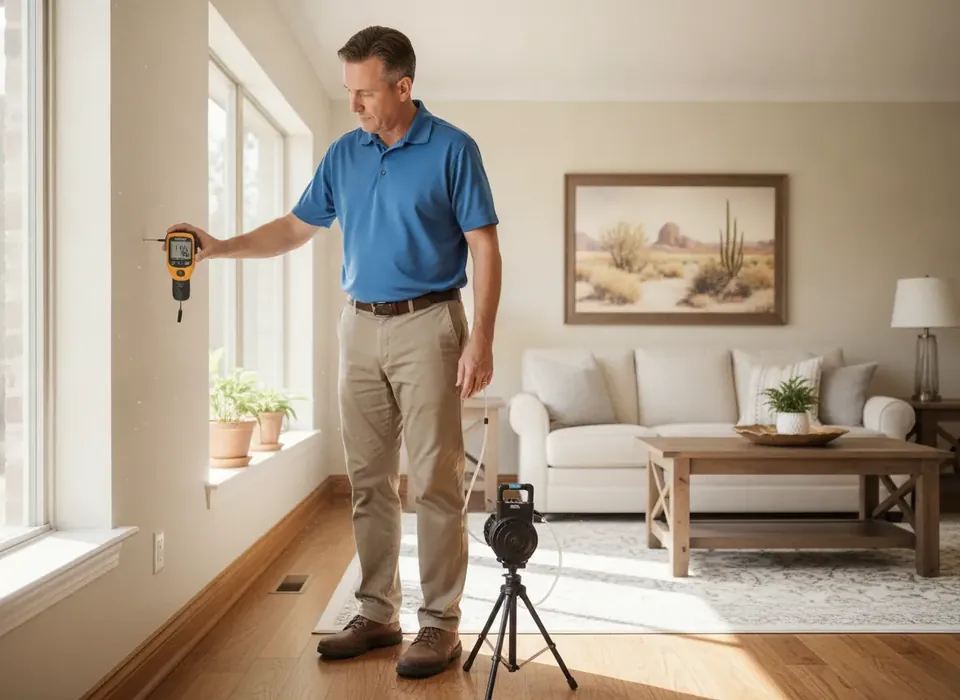
| What happens | A licensed assessor walks the home, looks for visible growth and staining, reads moisture in walls and floors with a meter, may use a thermal camera, and traces the water source | The assessor collects air samples with a pump, or swab and tape samples from surfaces, and sends them to a TDLR-licensed lab with a chain of custody |
| What you get | A written report describing where mold is, what is feeding it, and, if remediation is needed, a remediation protocol | A lab report listing spore types and counts, interpreted by the assessor against an outdoor sample |
| Answers the question | "Where is the water coming from and how much material is affected?" | "Is there more than normal in the air, and what kind?" |
| Typical published cost | $303 to $1,044 for the assessment (HomeAdvisor 2025, avg about $670) | Air-sample lab fees about $250 to $350 on top |
| Needed when | Almost always, and required at 25 contiguous sq ft or more | In specific situations (below) and for clearance if the protocol calls for it |
Typical published ranges, not quotes. Plano quotes come from the companies, not from this site.
One more term to clear up: a mold assessment is not a home inspection. A general home inspection before a purchase looks at the whole house and is a different license and a different report. A buyer worried about mold hires a mold assessor.
What TDLR and EPA say about testing
Two official positions shape this whole topic.
- EPA: in most cases, if visible mold growth is present, sampling is unnecessary. The response is the same regardless of species: fix the moisture problem and clean or remove the mold.
- TDLR: testing to identify the species of mold is usually unnecessary, and its Consumer Mold Information Sheet states there are no national or state standards for a safe level of mold.
That second point is the one to remember when a report lands in your inbox. A spore count is compared with the outdoor air that day, interpreted by a licensed consultant, and means little on its own. Anyone selling you a test as a pass-or-fail health verdict is overselling it.
The honest rule of thumb. If you can see mold and you know where the water came from, you need an inspection and a plan, not a lab bill. If you cannot see mold but something is wrong, or someone needs proof, testing starts to earn its cost.
When mold testing is worth it
Musty smell, nothing visible
Common in Plano: a slab leak under the floor, a wall cavity that got wet in the February 2021 freeze and was closed up, or attic insulation under a hail-damaged roof. Air sampling, paired with moisture mapping, helps decide whether to open a wall.
Clearance after remediation
Texas requires a licensed assessment consultant to conduct a post-remediation assessment using visual, procedural and analytical methods, while containment is still up (16 TAC 78.140). If the protocol calls for air or surface samples at clearance, those samples are part of the job and feed the Certificate of Mold Damage Remediation.
Someone needs documentation
A landlord-tenant dispute, an insurance claim, a home sale or a dispute with a builder. A lab report with chain of custody from a licensed lab carries weight that photos do not.
A doctor asked for it
If a physician treating someone in the household wants to know what is in the air, that is a medical question and testing is the way to answer it. See a doctor about symptoms; do not use a mold test as a diagnosis.
HVAC concerns
When the suspect source is the air handler or ducts, sampling at the supply registers can show whether the system is spreading spores, before anyone pays for duct cleaning. The AC repair itself is licensed HVAC work; see HVAC, duct and AC mold.
Why the assessor and the remediator must be different companies
This is the part of Texas law that protects your wallet. Under Occupations Code 1958.155, a license holder may not perform both mold assessment and mold remediation on the same project, and nobody may own an interest in both companies on that project. TDLR treats a violation as a Class C offense carrying a $2,000 to $5,000 penalty.
In practice the assessor inspects, writes the remediation protocol that says which rooms, how much material, what containment and what clearance criteria, and then returns after the work to confirm it passed. The remediator follows the protocol and hands you the certificate. The person who writes the scope is never the person paid by the square foot to carry it out. This site can connect you with both kinds of company, but never one that claims to do both. More on the licenses in assessor vs. remediator licenses in Texas.
What a Plano inspection visit looks like
Expect the assessor to ask about the history of the house first: any slab leak, roof claim, AC drain problem or storm damage. In a 1980s east Plano home that often means under-slab drain lines; in a 2000s two-story in west Plano or Frisco, the attic air handler. The visit usually takes an hour or two, the written report follows days later, and lab results add more time. Treat any timing a company gives you as its own estimate.
Ask for three things before you book: the company's TDLR license number (verify at tdlr.texas.gov/LicenseSearch), the Consumer Mold Information Sheet, which licensees must give you before work, and a sample report so you know what you are buying. Full details on the service are at mold inspection and testing in Plano, and overall job pricing is in the cost guide.
Under about 25 contiguous square feet, roughly a 5 by 5 foot patch, Texas does not require any of this and you may clean it yourself or hire anyone. Two cautions: a small patch is often the visible edge of a larger problem behind the wall, and if an unlicensed cleanup uncovers 25 square feet or more, the exemption is lost and licensed companies must finish the job (16 TAC 78.30).
Frequently asked questions
Do I need a mold test if I can already see mold?
Usually not. EPA says sampling is generally unnecessary when mold is visible, and TDLR says testing to identify the species is usually unnecessary because the response is the same: fix the water and remove the growth. A licensed assessment still matters for anything near 25 contiguous square feet, because Texas requires a written protocol and a clearance assessment on those jobs.
How much does a mold inspection cost in Texas?
HomeAdvisor's 2025 data puts a mold inspection by a licensed assessor at roughly $303 to $1,044, averaging about $670, with air-sample lab fees of around $250 to $350 on top when sampling is done. Plano prices come from the companies, not from this site. A written remediation protocol and a post-remediation clearance visit are often priced separately.
Can the same company inspect for mold and remove it in Texas?
Not on the same project. Texas Occupations Code 1958.155 bars a license holder from performing both mold assessment and mold remediation on one project, and bars common ownership of the two companies on that project. The split keeps the person who writes the scope and signs the clearance independent of the person paid to do the work.
Is there a safe level of mold on an air test?
No. TDLR's Consumer Mold Information Sheet states there are no national or state standards for a safe level of mold. Lab reports compare indoor samples with an outdoor sample taken the same day and are interpreted by the assessor. That is why a number on its own means little without the inspection that goes with it.
Get quotes from licensed assessors and remediators
Describe what you see, smell and suspect, and independent, TDLR-licensed Texas companies serving Plano, Frisco, McKinney, Allen, Richardson and the rest of Collin County will reply with free quotes for an assessment, remediation or both, from separate companies as the law requires. Request a free quote or call (972) 472-8749.